Table of Contents
- Overview
- Prerequisites
- Cost
- Key Considerations
- How to create a Self-Managed Walmart Marketplace US Integration
- Disconnecting a Self-Managed Walmart Integration
- Editing a Self-Managed Walmart Integration
- Managing a Self-Managed Walmart Integration
Overview
Self-Managed Integrations allow you to create and manage integrations directly within your CartonCloud account.
The Walmart Marketplace US Integration connects CartonCloud with your Walmart Marketplace US seller account to automatically create CartonCloud Sale Orders from Walmart orders. When a Walmart order is created, the integration creates the corresponding Sale Order in CartonCloud.
The integration will also sync fulfilment and tracking information back to Walmart when fulfilment is enabled. When the Sale Order is dispatched in CartonCloud and tracking details are added to the consignment, Walmart is updated with the shipment details and tracking information.
You can configure the integration yourself, or you can have your customer set the integration up from their CartonCloud login. See How to enable Customers to create their own Self-Managed Integrations.
Prerequisites
- You have an active Walmart Marketplace US seller account.
- You have permission to connect apps or integrations in Walmart Marketplace.
- You have permission to create Self-Managed Integrations in CartonCloud.
- The Product SKUs in Walmart Marketplace match the product codes in CartonCloud.
- The Customer in CartonCloud has access to the Warehouse used in the integration.
- Your Walmart fulfilment centers are active and available in Walmart Marketplace.
Cost
We offer volume-based discounts. Reach out to our support team to discuss pricing options.
Key Considerations
- The Walmart Purchase Order ID is used as the CartonCloud customer reference.
- Orders are routed to CartonCloud warehouses using Walmart Fulfillment Center to CartonCloud Warehouse Mapping. If a matching fulfillment center is not mapped, the selected default warehouse will be used.
- The integration can acknowledge Walmart orders once the CartonCloud Sale Order progresses beyond early statuses such as Draft, Awaiting Stock, or Rejected.
- Fulfilment updates are sent to Walmart when the CartonCloud Sale Order is dispatched and tracking details are available.
- Tracking numbers and tracking URLs are sent to Walmart when available. Tracking details can also be updated in Walmart if they change after the initial dispatch.
- Walmart requires supported carrier information for shipment updates. If the carrier is not recognised, a tracking URL must be available so the carrier can be sent as an “other carrier”.
- Manually editing products & quantities on imported Sale Orders is not supported, as it breaks the link with Walmart’s references.
How to create a Self-Managed Walmart Marketplace US Integration
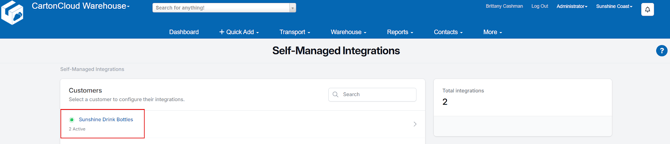
- Navigate to the Integrations page by typing Integrations in the Search for Anything bar, or go to More > Self-Managed Integrations.
- If you are an Admin user, select the customer you wish to create the integration for.
- Select Walmart Marketplace US from the Self-Managed Integrations menu selection.
- Click Configure.
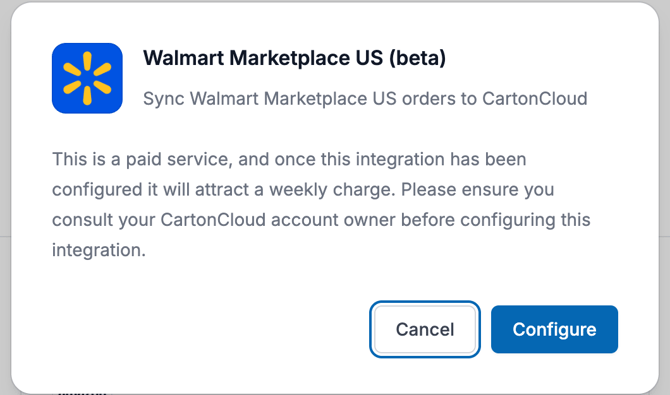
- The configuration box will now appear. Follow the steps below to configure the integration.
(1) Initial Configuration
- Fill in the Name field.
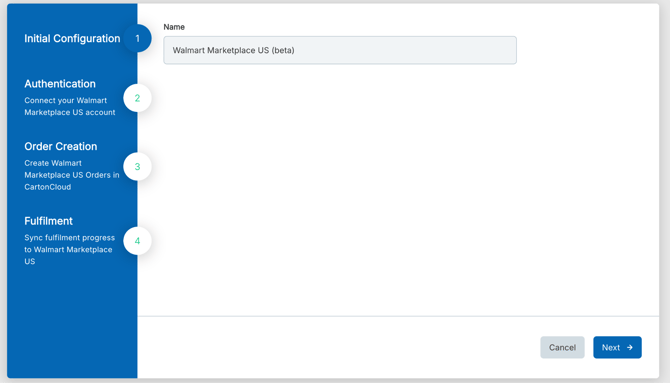
- Click Next.
(2) Authentication
- You will now need to connect CartonCloud to Walmart Marketplace US.
- Click Connect and log in to your Walmart Marketplace seller account.
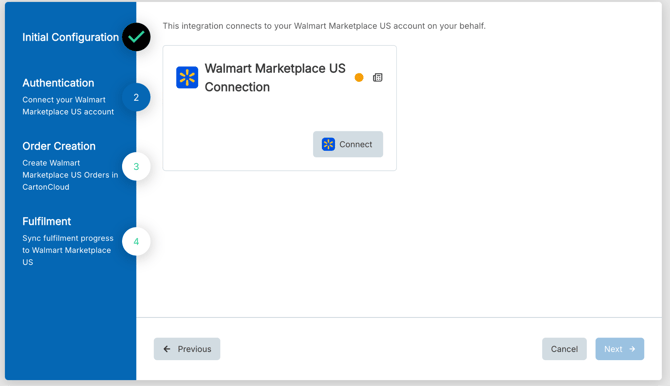
- Review the scopes necessary for the integration and proceed by clicking “Authorize”
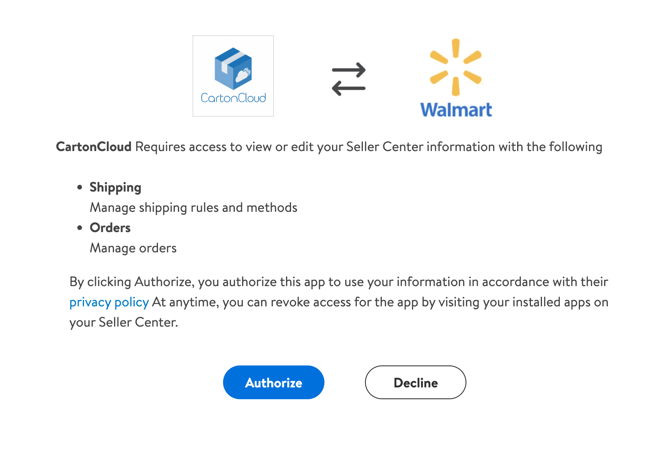
- Once redirected to a successful connection page you can close it and go back to the config wizard.
- Click Next.
(3) Order Creation
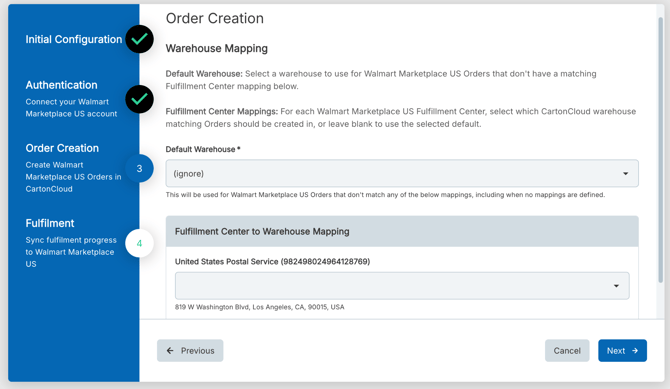
Here you will need to map which Walmart Marketplace US orders will go to which CartonCloud warehouse.-
- Default Warehouse: Select a CartonCloud warehouse to use for Walmart orders that do not have a matching Fulfillment Center to Warehouse Mapping.
If you choose to set a default warehouse, all orders will go to this warehouse unless you add Fulfillment Center to Warehouse Mapping.
- Default Warehouse: Select a CartonCloud warehouse to use for Walmart orders that do not have a matching Fulfillment Center to Warehouse Mapping.
-
- Fulfillment Center to Warehouse Mapping: Configure mappings to control where orders should be routed.
For each Walmart Fulfillment Center, select which CartonCloud warehouse Sale Orders should be created in, or leave blank to use the selected default.
- Fulfillment Center to Warehouse Mapping: Configure mappings to control where orders should be routed.
- Click Next.
(4) Fulfilment
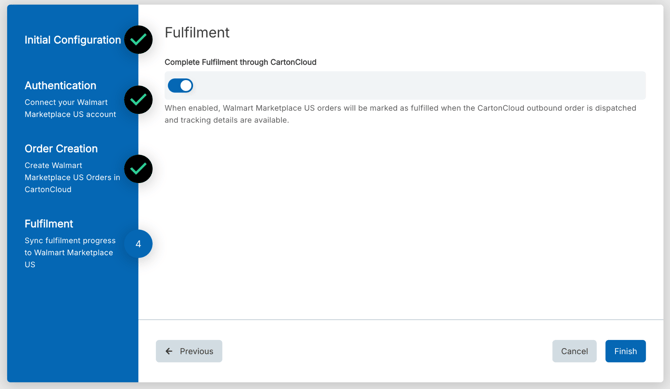
- Complete Fulfilment through CartonCloud: When enabled, Walmart Marketplace US orders will be marked as fulfilled when the Sale Order is dispatched in CartonCloud and tracking details are available.
- Tracking Information: Tracking information will be sent to Walmart when the order is dispatched, and will be updated if tracking details change.
- Click Finish.
Disconnecting an existing Self-Managed Walmart Marketplace US Integration
If you need to cancel and disconnect the integration you will need to:
- Navigate to the Integrations page.
- Select the relevant Customer.
- Click Walmart Marketplace US.
- Select the three-dot configuration icon and select Delete Integration.
- This will remove the integration and stop the billing of the integration to your account.
Editing an existing Self-Managed Walmart Marketplace US Integration
To edit an existing Walmart Integration:
- Navigate to the Integrations page.
- Select the relevant Customer.
- Click Walmart Marketplace US .
- Select Reconfigure.
Managing Self-Managed Integrations
Because Self-Managed Integrations are a paid feature, it is important you are able to manage and keep track of the number of active integrations your customers have. This is useful if you wish to pass on the cost to your customer and reconcile your invoices.
If a Customer has a live integration they will have a green dot icon against their name. It will also display the number of active integrations for that customer below their name.