Table of Contents
Purpose
To define one Unit of Measure for charging regardless of whether the Unit of measure is picked or put away.
Use Cases
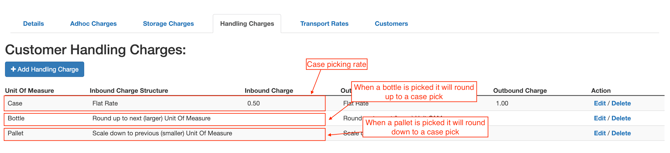
You are a wine distributor, and 6 bottles make up a case. Your customers can order in quantities of individual bottles; however, you always want to charge a case picking rate regardless of the units picked. In this scenario, you would configure the bottle charge to consistently scale up to the nearest case and charge in cases.
In this example, assume we have Bottles pick fee configured to Round up to next (larger) Unit of Measure (cases).
1 case picking fee = $0.50
|
Location |
Order/pick quantity |
No aggregation (default) |
|
AA-01-01 |
5 bottles |
Round up 5 bottles to 1 case Charge 1 Case |
|
AA-01-01 |
2 bottles |
Round up 2 bottles to 1 case Charge 1 Case |
|
AA-01-04 5 |
5 bottles |
Round up 5 bottles to 1 case Charge 1 Case |
|
Total Charge |
|
3 Cases = $1.50 |
How to charge one Unit of Measure for all Handling Charges
Following the same example, the below steps will show how to set up the same Unit of Measure for all Sale Order handling fees.
To set up this charging method, you need to:
-
Select the Picking Charge Option of, Default (Scale to Highest Unit of Measure) within the Rate Card Settings.
-
Create the Handling Charge and set up the Charge Behaviour to round up or down to the correct Product Unit of Measure.
Step 1 - Enable the correct Picking Charge Option
-
Navigate to the Rate Card page, More>Rate Cards.
-
Select the relevant Rate Card.
-
Click the Edit button at the bottom of the screen.
-
Scroll down to the Sale Order settings and select Default (Scale to Highest Unit of Measure) from the Picking Charge Option drop-down menu.

-
Select the Aggregation option you wish to use. Please click here for more information on aggregation.
Aggregation Options:
|
Picking Charge Aggregation Option |
Explanation |
|
No aggregation (default) |
Products will not aggregate together. |
|
Aggregate by SKU by Location |
CartonCloud will aggregate all products for a Sale Order in the same location, regardless of whether they are from different POP records. |
|
Aggregate by SKU across the entire warehouse |
Regardless of what location the products for a Sale Order are in, they will be aggregated. |
Example
Following the same previous example, assume we have Bottles pick fee configured to Round up to next (larger) Unit of Measure (cases).
(6 bottles = 1 case)
|
Location |
Pick/Putaway Quantity |
No aggregation |
Aggregate by SKU by Location |
Aggregate by SKU across the entire |
|
AA-01-01 |
5 bottles |
Round 5 bottles up to 1 case Charge 1 case |
Combine 7 bottles together (5+2) which converts to 1 Bottle + 1 Case Round 1 bottle + 1 case up to 2 cases Charge 2 cases |
Combine 12 bottles together (5+2+5), which converts to 2 cases. Charge 2 Cases |
| AA-01-01 |
2 bottles |
Round 2 bottles up to 1 case Charge 1 case |
||
|
AA-01-04 |
5 bottles |
Round 5 bottle up to 1 case Charge 1 case |
Round 5 bottles up to 1 case Charge 1 case |
|
|
Total Charge |
|
3 Cases |
3 cases |
2 Cases |
Step 2 - Set up the Handling Charge
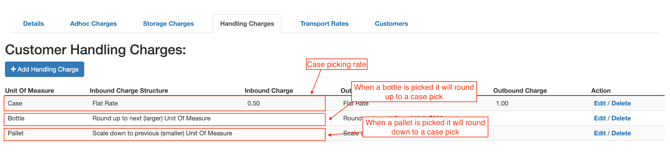
Following the same example, we will set up a Case picking fee for all Units of Measure (bottles, cases and pallets)
-
Navigate to the Rate Card page, More>Rate Cards.
-
Select the relevant Rate Card.
-
Select the Handling Charges tab.
-
Click Add Handling Charge.
-
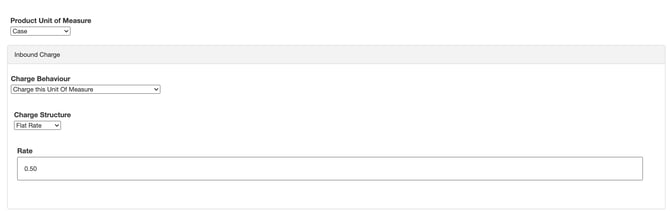
Select the Product Unit of Measure you wish to charge all picks by from the drop-down menu (In this example, Cases).
-
Select Charge this Unit of Measure from the Charge Behaviour drop-down menu.
-
Enter the rate for Cases picking charge.
-
Select Save.
-
Click Add Handling Charge.
-
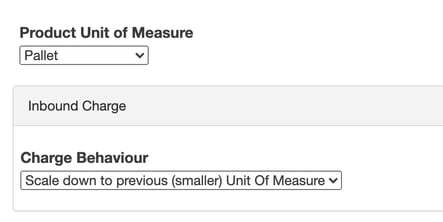
Select the higher Product Unit of Measure (in this example, Pallets) to that of the Unit of Measure you wish to be charging by from the drop-down menu.
-
Select Scale down to previous (smaller) Unit of Measure.
-
Select Save.
-
Click Add Handling Charge.
-
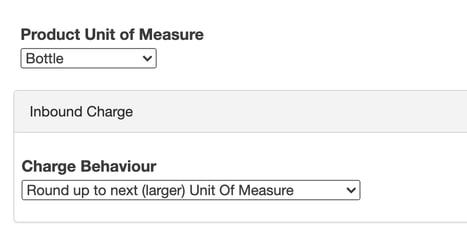
Select the lower Product Unit of Measure (in this example, Bottles) to that of the Unit of Measure you wish to be charging by from the drop-down menu.
-
Select Round up to next (larger) Unit of Measure.
-
Select Save.
This now means you will have three charges set up that will all point towards a Case charge.