
Table of Contents
- What is the customer stock report
- How to create the customer stock report
- Explanation of in warehouse, free, incoming and allocated
- Customer specific templates
What is the customer stock report
The Customer Stock Report is used to track the inventory of all Products stores in the given warehouse (that the report is being run on).
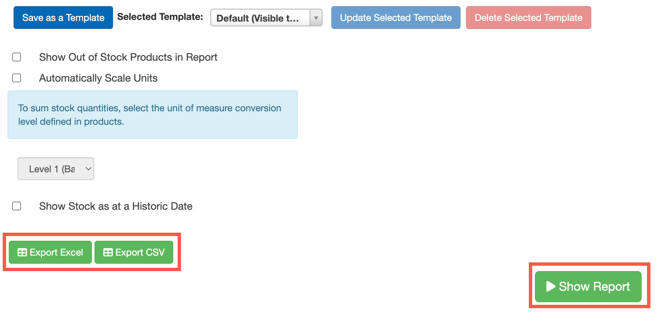
You can view the report in the web browser by clicking the Show Report button or you can export the report into an XLS file by clicking Export Excel.
Various columns can be added to the report for further customisation. The available columns are covered in the section below.
How to create the customer stock report
- Navigate to Customer Stock Report, Reports>Customer Stock Report.
- Select a specific Customer you wish to run the report for or select All to include all Customers.
- Select the columns you wish to include in the report by typing the column name and selecting from the drop-down. You can click +Add All Columns to include all columns or select the x on a column to remove it from the selection.
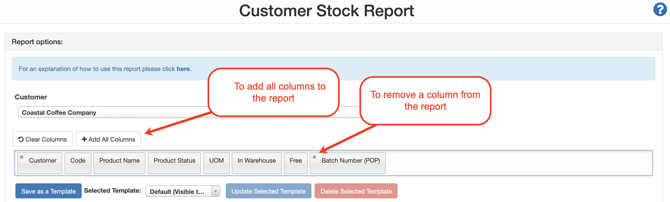
- The below table covers the columns that can be added to the report. Columns that are not included below are custom fields - the fields you have set up for your Customer. This will include fields such as batch number or serial number.
The default columns are locked and can not be removed. These columns will not have a x option on the name to remove it.
| Column Name | Locked | Description | Available to Customers |
| Code | Yes | The code of the Product line | Yes |
| Product Name | Yes | The name of the Product line | Yes |
| Product Status | Yes | The status of the Product line | Yes |
| UOM | Yes | The Unit Of Measure of the Product line | Yes |
| Location | No | The Warehouse Location of the Product line | No |
| In Warehouse | Yes | The amount of stock in the Warehouse of the Product line. This amount is a sum of both Allocated and Free columns | Yes |
| Allocated | No | The amount of stock of the Product line that has been allocated to Sale Orders | Yes |
| Free | Yes | The amount of stock of the Product line that has not been allocated to Sale Orders | Yes |
| Incoming | No | If the Incoming column is part of the report, then the amount of stock on Purchase Orders with a status of Not Yet Received will appear in this column on the Report. | Yes |
| ID | No | The Purchase Order Product (POP) ID. This will show the POPID without the prefix of CCPOPBCP. | Yes |
| Expiry | No | The set Expiry Date of the Product line | Yes |
| Pallet ID | No | If the Product line is stored in a bulk Warehouse Location, then it will show a Pallet Id representing what Pallet it resides on in that Warehouse Location | No |
| Product Group | No | The Product Group of the Product line if any | Yes |
| Product Type | No | The Type of the Product line | Yes |
| Purchase Order Reference | No | The reference of the Purchase Order that the Product line belongs to | Yes |
| Arrival Date | No | The arrival date of the Purchase Order that the Product line belongs to | Yes |
| # Pallets | No | The number of pallets at the given Warehouse Location | Yes |
The Warehouse Stock Report columns can be dragged and dropped in the order desired by simply clicking and dragging a tag to the desired position in the column order. Note that dragging fields to different places in the column order will result in slightly different results being displayed in the report as these options are also used to split the Product lines.
- Alternatively, if you have a saved template you can use that rather than specify the columns you wish to use each time. See Creating Report Templates for more information.
- Select the report options you wish to apply. See below for definitions of the different options.
| Report Option | Description |
| Show Out of Stock Products in Report | If this option is checked then you will both in stock and out of stock products appear in the report. NOTE: If you export the report to excel with this option set then you will get an excel file that has a sheet for In stock products and another sheet for Out of stock products |
| Automatically Scale Units | This option will make all stock counts showing in columns "In Warehouse", "Allocated", "Free", and "Incoming" in their highest possible unit of measure conversion (eg. If the Product line's highest unit of measure is a Pallet, then the counts shown in the report will be in Pallets with this option checked). See below for a way to scale to other UOM levels. |
| Show Stock as at a Historic Date | Checking this option will show a date field to choose which date you want to see stock for |
| Specify Date | This field appears if "Show Stock as at a Historic Date" is checked. You can enter the date you wish to see the historic data for in this field |
- To export the report click Export Excel or Export CSV. It is recommended that you use 'Export CSV' when the file is larger as it will make the download process more efficient. To view the report in the web browser select Show Report.
How the report will appear on the web:
How the report will appear when you download it:
Explanation of In Warehouse, Free, Incoming and Allocated
On the Stock Report, there are four different statuses the inventory can be in.
In Warehouse: Is in the warehouse and has not yet been packed in a Sale Order.
Free: Is in the warehouse and has not been allocated to a Sale Order yet.
Incoming: Stock that is on a Purchase Order but has not yet been received into the warehouse.
Allocated: Stock that has been allocated to an order but has not been packed yet.
| Sale Order Status | Product A Inventory Status | |||
| In Warehouse | Free | Incoming | Allocated | |
| Before Sale Order is raised | 10 | 10 | 0 | 0 |
| Rejected | 10 | 10 | 0 | 0 |
| Draft (Not allocated) | 10 | 10 | 0 | 0 |
| Draft (Stock allocated) | 10 | 5 | 0 | 5 |
| Awaiting Pick and Pack | 10 | 5 | 0 | 5 |
| Packed | 5 | 5 | 0 | 0 |
| Dispatched | 5 | 5 | 0 | 0 |
Customer specific templates
You can now create and save customer-specific templates, limiting the access to that customer.