
Table of Contents
- Purpose
- How to create a Wave Pick for a single customer
- How to complete a Wave Pick
- To complete a Wave Pick using paper
Purpose
To create a Wave Pick for a single Customer. If you wish to create a Run Sheet for more than one Customer, you will need to follow these steps.
Prerequisites
- The Sale Orders you wish to use in the Wave Pick must be in 'Awaiting Pick and Pack' status.
How to create a Wave Pick for a single Customer
-
Navigate to the Wave Picks page by selecting Warehouse>Wave Picks.
-
Select the green +Add Wave Pick button from the top left corner.

-
Select a Wave Pick Templates from the Prefill Settings drop-down menu or alternatively create a Wave Pick not using an existing template.
- Wave Picks can be automatically created using Advanced Automation. This is a WMS Premium feature only please see here for more information.
-
Select Customer from the Wave Pick Type drop-down menu.
-
Select the Customer you wish to create the Wave Pick for from the Customers with Wave-Pick Capable Sale Orders drop-down menu.

-
Select the Wave Pick Process Type. See Wave Pick Process Types for more information regarding the different Process Types and which will be best for your operations.
-
Edit the Wave Pick Name if you wish to change it from the auto-generated name.
-
You can then have a number of filters to choose from to select which Sale Orders you wish to add to the Wave Pick. These filters include:
- Product: the products on the Sale Order.
- Expected Delivery Run: the expected Delivery Run of the Sale Order.
- Urgent order: if the order is urgent or not.
- SKU Count: the number of SKU's on the Sale Order.
- Quantity Count: the quantity of item on the Sale Order.
- Ship Date: the Ship Date of the Sale Order.
- Required Delivery Date: the Required Delivery Date of the Sale Order.
- Product Type: the Product Type of the products on the Sale Order. For more information on Product Types see here.
- Product Group: the Product Group of the products on the Sale Order. For more information on Product Groups see here.
- Products located in Warehouse Zones: to include products located in specific Warehouse Zones.
- Product Filters Behaviour: if a product, product type or product group is selected then the product filter behaviour can be selected. The options include:
- Find orders if they contain a product that matches the selected filters: Sales Orders that contain products selected, but the orders can also contain other products not selected.
- Find orders only if all products match the selected filters: Sale Orders that only contain products selected.
- Exclude orders containing products which match the selected products: Sale Orders containing products selected will not be included.
-
When utilising the Product filter you will need to select a Product Filter Behaviour.
-
Find orders containing at least one of the selected Products: Sale Orders containing at least one of the selected Products will show as an available Sale Order to add to the Wave Pick.
-
Find orders containing only the selected Products: only Sale Orders with only the selected Product will show as an available Sale Order to add to the Wave Pick.
-

-
This will now show you all available Sale Orders according to the filters selected that can be added to the Wave Pick (for a Sale Order to appear here it must be in a Awaiting Pick and Pack status and not be assigned to another Wave Pick)
- Select the Sale Orders you wish to include in the Wave Pick by ticking the Select box in the far left column.
-
Once all relevant orders are selected, click Begin Wave Pick.
Note, when Sale Orders are added to a Wave Pick, their status is automatically updated to 'Packing in Progress'
How to complete a Wave Pick
Once you have created the Wave Pick you then have two options for completing the Wave Pick. You can either complete the Wave Pick;
-
On the mobile app
-
On the web app
-
On the web app using paper
Completing the Wave Pick on the mobile app
For instructions on completing the wave pick through the mobile app please see Scan Wave Picking
Completing the Wave Pick on the web app
When completing the Wave Pick on the web app, you can either pick per-product or per-order.
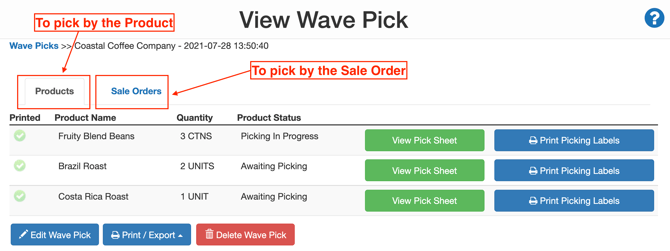
Picking Per-Product on the Web App
-
Select View Pick Sheet next to each product.

-
Pick the required quantities. As the stock is picked, enter the quantity and select the Completed box.
-
Select the green Complete Picking button.
-
The Product Status will inform you if the picking has been completed or not.

Picking Per-Order on the Web App
-
Select the blue Pack Sale Order button next to each Sale Order.
-
Picking per order uses the same interface as regular, non-wave picking.
-
Enter the PACKED QTY.
-
Select the green Finished Packing button.
-
You will be directed to the Sale Order/Consignment Screen. To go back to the Wave Pick from the Sale Order, select Go Back to Wave Pick.

Completing a Wave Pick on the Web App
-
Once all products/orders have been picked, select the green Complete Wave Pick button on the bottom of the screen.

-
This will update the status of all orders to 'Pack' and delete the Wave Pick.
To complete a Wave Pick using paper
-
Select the blue Print/Export button at the bottom of the screen.
- Select Export Bulk Pick List.

-
Open the downloaded XSL file (example of the file below).

-
Complete picks using the paper to mark off products as they are picked.
-
To complete the packing process, select the blue Print/Export button at the bottom of the screen and click Export Individual Pick Lists.
Even if using paper to complete the Wave Pick, you will need to complete the Wave Pick on the web app.